


MVR Technology & Ath-chomhbhrú Meicniúil Gal (MVR) Steam Compressors: The Ultimate Guide to Industrial Energy Savings
What is Mechanical Vapor Recompression (MVR) Teicneolaíocht?
Ath-chomhbhrú Meicniúil Gal (MVR ) is an advanced thermal evaporation process. Instead of wasting the low-pressure steam generated during boiling, an MVR comhbhrúiteoir gaile captures, re-pressurizes, and heats it up. seo “recycled” steam is then fed back into the system as the primary heat source.
How Does Mechanical Vapor Recompression (MVR) Evaporation Work? (Step-by-Step)
- Evaporation: Industrial liquid is boiled, creating low-temperature secondary steam.
- Compression: The MVR compressor mechanically compresses this steam, drastically increasing its temperature and pressure.
- Heat Recycling: The superheated steam is redirected to the evaporator’s heating tubes, transferring its latent heat back to the incoming liquid.
- Condensation: After releasing its heat, the steam condenses into high-purity distilled water.
The Result: A closed-loop system that requires only electricity to run the compressor, eliminating the need for expensive fresh boiler steam[1](@ref).

Why Choose MVR? 3 Core Advantages for Modern Industries
- 🚀 Superior Energy Efficiency: Reduces operational costs by 60% chuig 90% compared to traditional multi-effect evaporators.
- 🌡️ Mild Evaporation Conditions: Operates at lower temperatures (40° C – 80° C), protecting heat-sensitive materials like pharmaceuticals and food extracts.
- 💧 Zero Liquid Discharge (ZLD): Maximizes wastewater concentration, minimizing waste volume and helping factories meet strict environmental regulations.
The Heart of the System: Types of Ath-chomhbhrú Meicniúil Gal (MVR)
Tá an MVR comhbhrúiteoir gaile is the engine of the entire operation. Selecting the right type is critical for system stability. The two dominant types are Roots (Positive Displacement) agus Centrifugal compressors.
| Feature | Ath-chomhbhrú Meicniúil Gal (MVR) | Centrifugal MVR Compressor |
|---|---|---|
| Prionsabal Oibre | Dual-rotor parallel structure; traps and compresses steam via synchronized counter-rotation. | High-speed impeller converts kinetic energy into pressure energy. |
| Best Application | Low-to-medium pressure differentials; medium flow rates. | High-flow, cásanna ardbhrú-cóimheas (large-scale plants). |
| Maintenance | Struchtúr simplí, robust, easy to maintain. | Complex, requires specialized maintenance. |
Deep Dive: How a Roots MVR Compressor Works
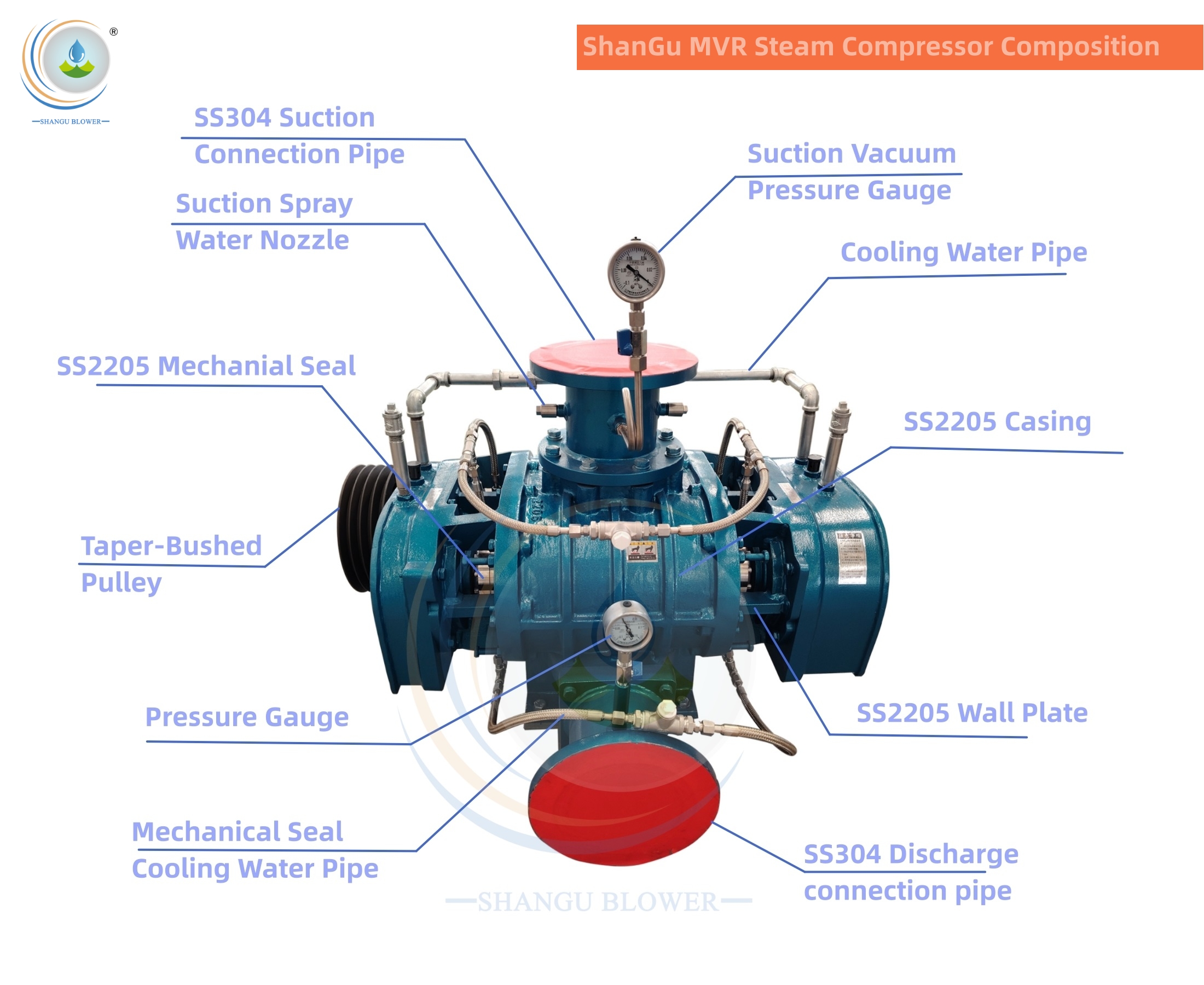
Ath-chomhbhrú Meicniúil Gal (MVR) are the workhorses of MVR systems. They feature two figure-eight impellers rotating in opposite directions. A small, water-sealed gap prevents metal-to-metal contact, ensuring extreme durability. When the trapped steam (“basic volume”) reaches the outlet, high-pressure steam flows back to equalize pressure, completing the compression cycle[1](@ref).

Revolutionizing Industries: Key Applications of MVR Systems
- Bia & Deoch: Concentrating fruit juices, milk, and sugars without scorching or destroying nutritional value.
- Cógaisíocht: Gentle solvent recovery and API (Active Pharmaceutical Ingredient) tiúchan.
- Lithium Battery Manufacturing: Precise crystallization of battery-grade lithium carbonate for EV batteries.
- Ceimiceach & Cóireáil Fuíolluisce: Processing high-salinity brine and achieving Zero Liquid Discharge (ZLD).
-
MVR comhbhrúiteoir gaile
Ceisteanna Coitianta (CC)
What is the main disadvantage of MVR technology?
The primary drawback is the higher upfront capital expenditure (CAPEX) compared to traditional open steam evaporation. Cén dóigh faoin spéir a ...?, the massive reduction in operational expenses (OPEX) usually results in a full ROI within 1 chuig 3 cian go raibh.
Can MVR handle corrosive industrial wastewater?
Tá. Modern MVR systems can be constructed using highly corrosion-resistant materials like Titanium, Hastelloy, or duplex stainless steels, allowing them to handle aggressive chemicals and high TDS (Total Dissolved Solids).
Conas a dhéanann comhbhrúiteoir gaile Roots (Ath-chomhbhrú Meicniúil Gal(MVR)) obair?
Glacann sé struchtúr comhthreomhar dé-rotor, le dhá impeller á dtiomáint ag giaranna sioncrónacha, ag rothlú i dtreonna os coinne ag an luas céanna.
A bearna beag (de ghnáth séalaithe le huisce spraeála) fágtha idir an impeller agus an chásáil agus plátaí balla chun teagmháil miotail-go-miotail a sheachaint.
Níl na calafoirt inlet agus asraon ceangailte go díreach, ag foirmiú dúnta “toirt bhunúsach.”
Nuair a rothlaíonn an toirt bunúsach go dtí an calafort asraon, sreabhann an gaile ardbhrú ar ais láithreach chun an brú a chomhionannú, comhbhrú díláithrithe dearfach a bhaint amach.
Ní mór don chóras MVR timpeallacht dhifreálach brú tosaigh a sholáthar; nuair a bunaíodh, tá an oibríocht thar a bheith cobhsaí agus iontaofa.
Nóta: Chomh maith le Roots MVR comhbhrúiteoirí Gaile, comhbhrúiteoirí lártheifeacha a úsáidtear go coitianta freisin i ard-sreabhadh, cásanna ardbhrú-cóimheas; is féidir an cineál cuí a roghnú bunaithe ar riachtanais tionscadail.
