
Treoir Ceannaigh Roots séidire & Rialacha Réimse: Conas a Sonraigh, Rith, agus Seirbhís do Shéidire Lúb Rothlach Roots (Gan é a scrios)
If you’re sourcing a sé séidire fréamhacha, comparing a comhbhrúiteoir séidire fréamhacha package, or looking for a reliable roots blower factory that can also handle séidire fréamhacha seirbhíse upgrades and spare parts—this guide is written for your engineers and your procurement team.
Below is a practical, field‑tested walkthrough: how a fréamhacha séidire lobe rothlacha actually works, what to specify before you buy, the six “never skip” operating rules that prevent overheating and overload, and how to structure an RFQ so suppliers can’t hide costs.
What a Roots Blower (Rotary Lobe PD Blower) Actually Is
A sé séidire fréamhacha is a positive‑displacement (PD) air mover. Two synchronised lobes (most commonly three‑lobe today) trap a fixed pocket of air at the inlet and carry it to the discharge without internal comhbhrú. Pressure rise happens go seachtrach—the system backpressure (static head + friction + device losses) sets the operating pressure, not a squeezing action inside the casing.
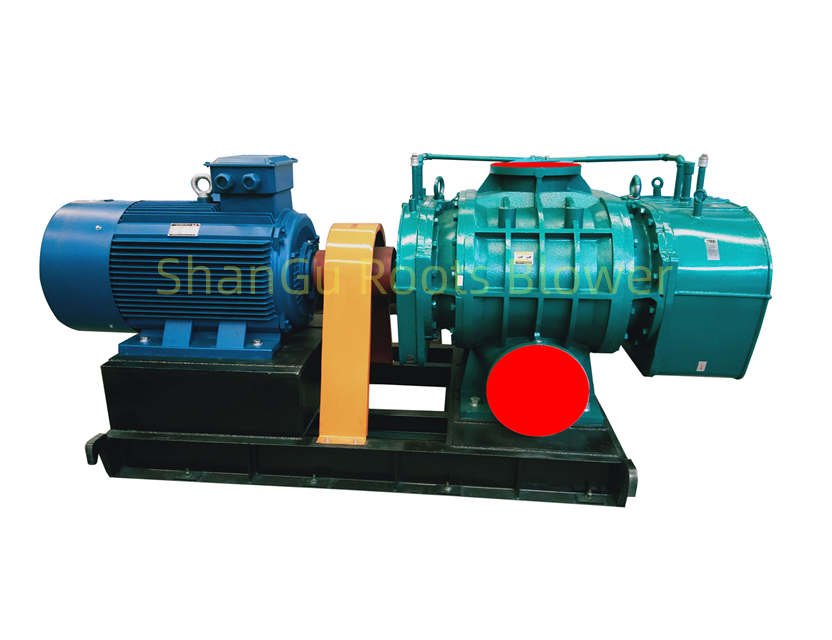
That’s why the industry also calls it a fréamhacha séidire lobe rothlacha, and why people sometimes say comhbhrúiteoir séidire fréamhacha when they really mean a blower package(blower + mótair + bonnphláta + silencer/valves) that delivers oil‑free air at low‑to‑moderate pressure.
What organizations like agus care about is how these air‑moving devices are tested, rated, and applied safely in real systems—relief sizing, inlet conditions, and controlled start/stop procedures matter as much as the bare flow number.
Where Roots Blowers Are Specified Most Often
You’ll see fréamhacha séidire lobe rothlacha packages specified heavily in:
- Wastewater aeration / STP aeration basins (continuous‑duty, oil‑free air, stable volume flow, easy redundancy)
- Iompar neomatach (dry bulk: stroighin, fly ash, plastic pellets, flour, srl.)
- Combustion air/kiln air/furnace air (oil‑free path, steady CFM)
- Process gas duty (bithghás, CO₂, VPSA auxiliaries—when materials/seals are selected correctly)
- Vacuum booster staging (configured for suction duty with proper safeguards)
Major water/wastewater suppliers openly discuss how blower selection (PD lobe vs screw vs turbo) and control strategy drive energy and compliance outcomes; see, for example, discussions from agus on specification logic and lifecycle thinking.
Six Operating Rules That Protect Your Sé séidire fréamhacha (and Your Budget)
These are the “load‑run” rules your operators should post next to the starter. They come directly from the checklist you already shared—refined into executable field language.
Rule 1 — Never “kill it live”: unload first, then stop
A sé séidire fréamhacha is a PD machine. If you trip or switch off under full backpressure, you risk pressure shocks, reverse thrust, and damage to rotors/gears/non‑return valves.
Safe mental model:
Open the relief/bypass (vent/blow‑off) path → confirm pressure dropping → then stop.
(Reserve hard emergencies for real emergencies—and still verify your Seiceáil an chomhla and relief setting afterward.)
Rule 2 — Never throttle by closing inlet or outlet valves
Running with inlet or outlet choked is a classic way to create overload and overheating. PD blowers aren’t centrifugal fans—flow doesn’t “fall off” safely; pressure keeps climbing until something gives.
Your system should control flow with:
- a proper relief valve (correctly sized, regularly verified), agus
- a bypass/vent (blow‑off) line or VFD strategy—not with half‑closed isolation valves.
This is also where industry associations’ safety/application culture matters: and equipment institutes consistently push for pressure relief, LOTO, and controlled energy as part of safe machine operation.
Rule 3 — Don’t recycle hot discharge back into the inlet for long (and never without cooling)
Long‑term discharge‑to‑inlet recirculation heats the inlet air, reduces density, and can push the whole machine out of its thermal comfort zone.
If your process needs recirculation/trim control:
- route it through a dedicated bypass with cooling/separation, not a quick “pipe straight back” hack, agus
- watch teocht inlet (many OEM specs reference an inlet air ≤ ~40°C design condition—verify against donameplate/system design).
Rule 4 — Watch temperatures & vibration like a hawks (and log them)
Typical OEM operating guardrails you’ll see on nameplates/service manuals:
- Rolling bearing temperature often monitored with an upper limit around 95°C (many plants set earlier warnings at ~75–80°C and a shutdown nearer 90–95°C per OEM).
- Lubricating oil/gearbox oil temperature commonly kept below ~65°C; if it creeps higher, you check: oil grade/level, cooler performance, overload/backpressure, and contamination.
- Creathadh is often checked near bearings; some plants reference ≤6.3 mm/s as a conservative control target, while formal machinery vibration frameworks (e.g., ISO 10816 family) are used to set condition‑based alarm/shutdown bands by machine class.
Bottom line: don’t just “eyeball.” Log bearing temp, oil temp, pressure differential, motor amps, and vibration per shift. Trending beats thresholds alone.
Rule 5 — Treat lubrication as a daily discipline, not a monthly formality
Your note about leibhéal ola, splash/feed, and oil condition is exactly right. In practice:
- Keep oil between the sight‑glass marks (not “extra full”).
- Replace/refresh on a schedule tied to uair an chloig + contamination signs (foaming, milky color, particulates).
- Verify breather/filter cleanliness—restricted breathing quietly cooks oil.
Rule 6 — Load gradually; never “yank” it to full duty
Correct sequencing (very common in PD blower startups):
- Bypass/vent open → start motor (near no‑load) →
- slowly close vent to build to target pressure →
- adjust flow with bypass trim or VFD, not by strangling the main line.
If your package uses a bypass line with a hand/control valve, the valve schedule should be written into the SOP so “gradual” is defined in seconds/minutes, not guesses.
How to Write an RFQ That Gets You a Real Quote (Not a Guessing Game)
If you want a roots blower factory to respond with a buildable, warrantied proposal instead of a generic price, send this:
Your duty (not just “model XX”):
- Required sreabhadh at your inlet conditions (m³/min or CFM; specify ° C, altitude, humidity if extreme)
- Required brú urscaoileadh / ΔP (kPa/barg or psi)
- Continuous vs intermittent duty, hours/day
Your constraints:
- Noise limits / enclosure required?
- Water‑cooled or air‑cooled preference?
- Explosion‑proof area classification (NEC/ATEX/IECEx)?
- Inlet air cleanliness (dust loading, filters already existing?)
- Voltage/frequency (ex: 415V/50Hz, 480V/60Hz) & control style (VFD/soft starter/direct‑on‑line)
Your “don’t forget” list:
- Relief valve setpoint confirmation (and who sizes it)
- Non‑return valve orientation & access
- Spare parts kit (seals, scagairí, cúpláil, belts if belt‑drive)
- Commissioning support / séidire fréamhacha seirbhíse interval recommendation
Why Buyers Choose a Dedicated Roots Blower Factory Partner (and What to Verify)
A real roots blower factory isn’t just welding a casing and bolting a motor. You should be able to verify:
- Proven three‑lobe rotor machining/clearance control & timing‑gear setup procedure
- Test runs (no‑load or simulated load) & log sheets (brú, amps, noise/vibration if required)
- Clear documentation: nameplate data, lubrication table, exploded drawing, spares list
- After‑sales: séidire fréamhacha seirbhíse response time, field audit option, rebuild criteria
If you want, tell me application + sreabhadh + brú + voltas, and I’ll send back a clean RFQ pack template + a one‑page specification sheet you can forward to any supplier so answers become comparable.
CC
C: Is a “roots blower compressor” the same as a roots blower?
A: People often use comhbhrúiteoir séidire fréamhachato mean a packaged compressed‑air system (blower + mótair + tostóirí + relief + bypass). The blower itself is a positive‑displacement lobe blower, not a dynamic compressor.
C: What’s the “safe” bearing temperature on a roots rotary lobe blower?
A: Many OEMs treat ~95°C as a hard upper bound for rolling bearings, with earlier warnings set lower. Always follow your unit’s manual—and trend temps over time.
C: Can I control flow by partially closing the outlet valve?
A: Not safely. Use a comhla faoisimh, bypass/vent, nó VFD strategy. Throttling a PD blower by choking valves is a fast track to overload.
C: Do you supply internationally as a roots blower factory?
A: Yes—we ship packaged fréamhacha séidire lobe rothlacha units with export packing, documentation, and remote commissioning guidance; on‑site séidire fréamhacha seirbhíse support depends on region and scope.
Get a Quote / Talk to a Factory Engineer
If you’re comparing suppliers and want straight answers on lead time, test reports, and lifecycle cost—open a conversation with our engineering team and attach your duty specs (or even a photo of your existing nameplate). We’ll confirm whether a standard comhbhrúiteoir séidire fréamhacha package fits, or whether your system needs a custom bypass/control scheme.
Request a Roots Blower Quote⇒mail to vincent@cnrootsblower.com.
Service Request⇒Book a service roots blower audit/spares.
