
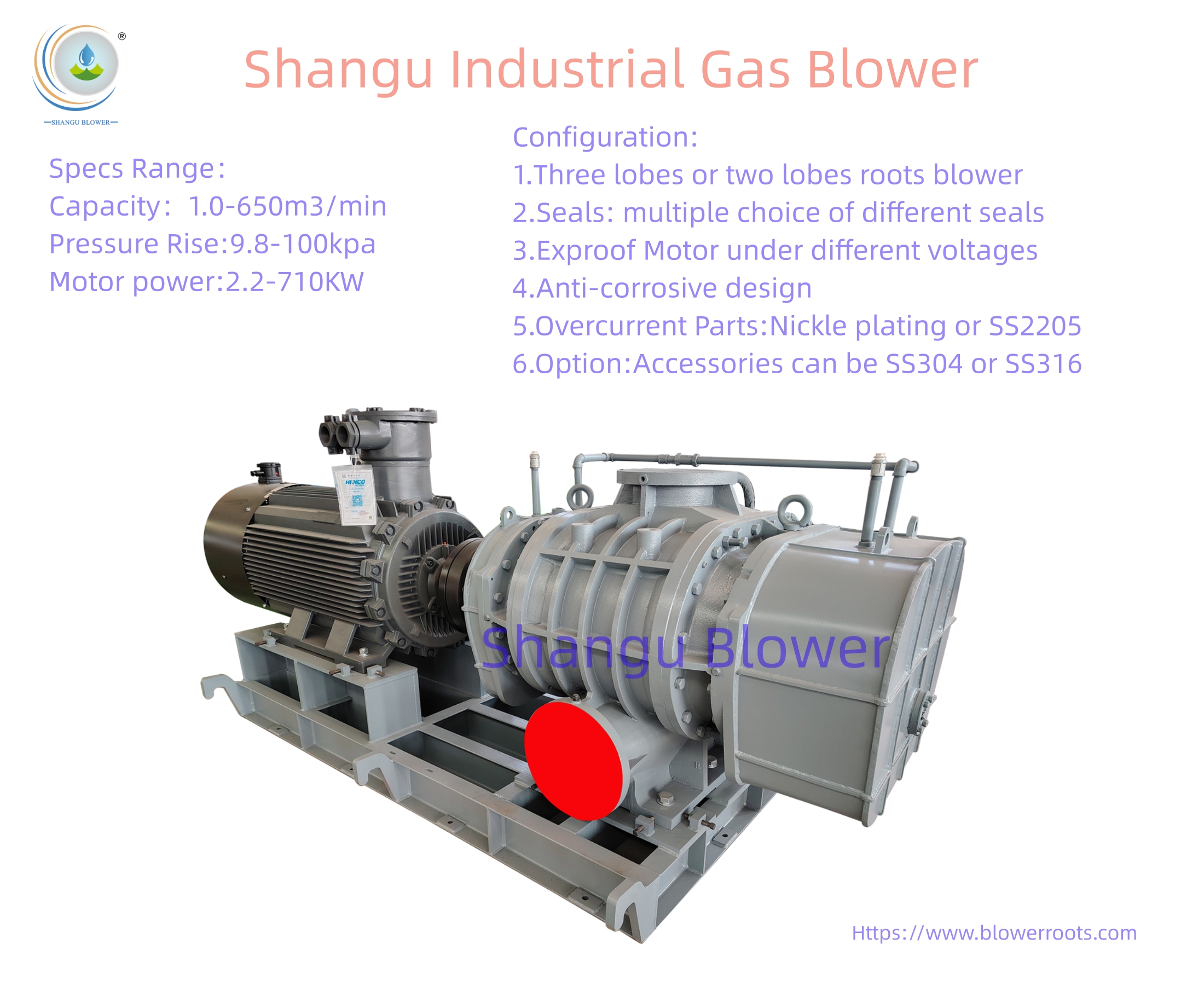
Industrial gas blower packages (ar a dtugtar freisin comhbhrúiteoirí Roots),in the realm of industrial gas handling, tagtha chun cinn mar threalamh fíor-riachtanach chun gáis a iompar agus a bhrú ar fud earnálacha éagsúla. Their unique design and operational principles make them particularly suited for handling special gases such as corrosive, flammable, or high-purity compounds. Below, we explore the distinct advantages of Industrial gas blower packagess in specialized gas transportation, supported by technical insights and real-world applications.
1. High-Pressure Stability & Flow Consistency
Roots blowers excel in maintaining stable flow rates even under fluctuating pressure conditions. Unlike centrifugal compressors, which suffer from efficiency drops under high-pressure scenarios, Roots blowers utilize a dual-rotor system (two or three lobed rotors) to generate consistent displacement. This design ensures minimal flow variation (±1% fluctuation) across pressure ranges of 9.8–250 kPa, making them ideal for critical applications like:
Chemical processing: Transporting toxic gases (e.g., clóirín, hydrogen sulfide) with pressures up to 200 kPa .
Oil and gas: Pressurizing natural gas or flare gas in refineries, where pressure stability is vital for combustion efficiency.
Semiconductor manufacturing: Delivering ultra-high-purity nitrogen or argon with contamination-free delivery .
2. Corrosion Resistance & Material Durability
Specialized gas applications often involve aggressive chemicals or abrasive particulates. Roots blowers address this through:
Material selection:
Copper or SS2205 stainless steel rotors for resistance to acids (e.g., sulfuric acid) and chlorides .
Hard-coated seals(e.g., Pistol Ring+back flow) to withstand abrasive dust in metallurgical or mining sector
Sealing innovations:
Multi-stage labyrinth seals reduce leakage rates to <0.001%, ensuring gas purity in pharmaceutical or food-grade applications .
3. Explosion-Proof & Safety-Critical Design
For flammable gases like methane or hydrogen, Roots blowers incorporate:
Non-lubricated operation: Eliminates oil contamination risks, critical for gas purity in refinery FCC units or hydrogen fuel cells .
ATEX/IECEx certifications: Motors and casings designed to prevent ignition sources in explosive atmospheres.
Pressure relief systems: Integrated safety valves to handle overpressure scenarios, as seen in LNG terminal gas recovery systems .
4. Energy Efficiency & Low Operational Costs
Pacáistí séidire gáis tionsclaíoch outperform traditional compressors in specific niches:
Low specific energy consumption: Achieve 75–89% efficiency in medium-pressure ranges (50–150 kPa), reducing energy costs by 15–30% compared to reciprocating compressors .
Variable speed drives (VSD): Adjust rotational speed (150–3,000 RPM) to match demand, slashing power waste during partial-load operations .
Minimal maintenance: With only two moving parts (rotors), annual downtime is reduced to <24 uair an chloig, as reported in cement plant case studies .
5. Customizable Solutions for Extreme Conditions
Roots blowers are adaptable to harsh environments:
High-temperature resilience: Cooling jackets and heat-resistant greases enable operation at 60°C+ in steelmaking blast furnaces .
Anti-corrosion coatings: Epoxy or fluoropolymer linings extend service life in chlorine gas pipelines by 3–4 times .
Dust-tolerant configurations: Inlet cyclones and self-cleaning filters handle particulate loads up to 1,000 mg/m³, common in biomass gasification plants .
