
🏭 完整指南: 羅茨旋轉葉鼓風機 Applications in Lime Kiln Process Systems (三月 PFR & 雙豎窯)
為什麼這很重要: Active Lime = Steel Plant Profitability
Steel mills don’t burn limestone directly in the converter. 他們首先將其煅燒:
CaCO₃ → CaO + CO2 ΔH ≈ +177.8 千焦耳/摩爾 (吸熱的)
Done right — in a dedicated lime kiln at 900–1,200 °C — you get high-reactivity (active) 萊姆 with consistent CaO purity, low residual CO₂, and the fast slag-formation steelmaking demands. Done wrong, you’re fighting off-spec product, refractory abuse, and blown energy budgets.
The hidden enabler behind consistent calcination? Air movement. And in lime kilns — especially 三月 PFR (Parallel Flow Regenerative) / double-shaft kilns — that means 羅茨鼓風機.
TL;DR — Where Roots Rotary Lobe Blowers Go in a Lime Kiln
| # | System | What It Does | Why Positive Displacement Wins |
|---|---|---|---|
| ① | 燃燒空氣 / primary air blower號 | Forces air to the burning shaft for fuel oxidation | Constant CFM despite fluctuating bed resistance |
| ② | Lime cooling air blower號 (bottom / external cooling) | Counter-flow cools CaO from >900 °C → ~40–60 °C & recovers heat | Recovers sensible heat as preheated combustion air |
| ③ | Suspension / hanging-cylinder cooling blower號 | Dedicated forced-air cooling of the kiln’s structural hanging cylinder | Safety-critical — overheating = irreversible deformation |
| ④ | Burner-lance / nozzle cooling blower號 | Forms a cooling air film around pulverised-coal / gas lances | Prevents lance warping & tip coking under radiant load |
| ⑤ | Internal cooling / air-cap cooling blower號 | Cools internal lime bed zones & protects distribution caps | Maintains uniform airflow geometry |
| ⑥ | Gas-boost / gas-pressurising blower號 (byproduct gas lines) | Steps low-pressure BF gas / coke-oven gas / carbide-furnace gas up to kiln-injection pressure | Positive displacement = flow-metered, even with dirty/light-dust gas |
(Classic Maerz PFR installations typically deploy 4–5 roots-type blowers for combustion air和 3–4 for cooling air, sourced from a central blower house.)

The Engineering Logic: Why a 羅茨旋轉葉鼓風機 Instead of a Centrifugal Fan?
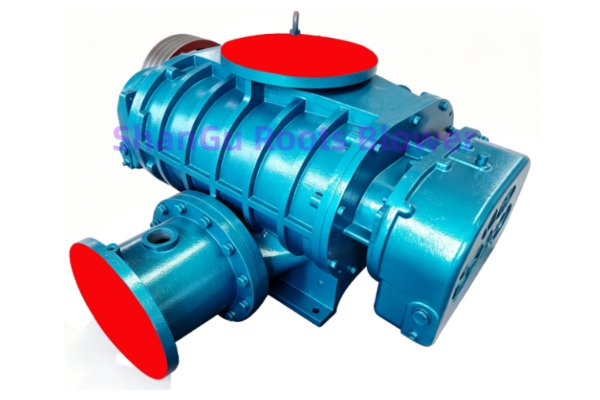
一個 根鼓風機號 (也稱為 羅茨旋轉葉片鼓風機 or — when people speak loosely — a 羅茨鼓風機壓縮機 in the low-pressure regime) 是一個 正位移 (PD) 鼓風機. Two figure-8 (or 3-lobe) rotors mesh synchronously, trapping fixed gas pockets and transferring them from suction to discharge.
This matters in a lime shaft kiln because:
| Kiln Condition | Centrifugal Fan Behaviour | 根源 / PD Blower Behaviour |
|---|---|---|
| Bed resistance shifts as stone size distribution changes | Flow drops as back-pressure rises → uneven calcination | Flow stays tied to rpm號 (Q ≈ constant) → stable O₂ delivery |
| Cyclic reversal every 10–15 min (PFR shaft swap) | Surge / unstable operating point risk if not perfectly sized | Natural immunity — PD output isn’t curve-sensitive in the same way |
| You need N+1 redundancy & simple controls | Complex VFD + damper sequencing | VFD on PD = linear CFM control, trivial staging logic |
| Dusty intake air / ~ambient-but-warm plant air | Fouling-sensitive aerofoil profiles | Robust cast-iron casing, generous internal clearances, forgiving of particulate |
⚠️ Honest note: Maerz themselves have documented that high-pressure radial fans can beat a conventional roots blower on electric efficiency(80–86 % vs ~60–65 %) and reduce the total machine count. But those retrofits assume specific fuel types, careful acoustics, and re-engineered ductwork. For greenfield plants, byproduct-gas boosting, and sites needing rock-solid flow certainty across wildly swinging backpressures, 這 羅茨旋轉葉片鼓風機 remains the safe, proven backbone — and often the requiredchoice for gas-pressurising duties.
深入探討: 這 6 Roles of roots rotary lobe blower in Detail
① Combustion Roots Rotary Lobe Blower (Primary Air) — The Heartbeat
In a PFR double-shaft kiln, combustion air is introduced at the top of the burning shaft, travels parallel to the descending stone, and meets fuel injected through vertical lances evenly spaced across the cross-section.
你的 根鼓風機 must:
- Deliver a calculated mass flow of O₂ matched to the fuel calorific value & excess-air target (通常 λ ≈ 1.05–1.30 for clean flame control)
- Push through stone-bed resistance + lance-nozzle drop + duct losses — often landing in the 30–60 kPa (≈4–9 psig) discharge range for larger kilns
- Accept cyclic reversal: when shafts swap (~every 10–15 min), the combustion air path switches; the blower itself may stay online while motorised diverter valves route the flow
Pro tip: Size for the maximum sustained backpressure condition, not average. In limestone with variable fines content, bed ΔP spikes. A PD blower shrugs it off; a centrifugal stalls.
② Lime Cooling Roots Rotary Lobe Blower — Where Efficiency Is Actually Made
Cooling air enters at the kiln bottom and rises in counter-flow against the descending lime. It leaves the cooling zone already preheated — then merges with process gas and crosses over into the regenerative shaft, where it transfers that stored heat to the next batch of stone.
This is why lime kilns tolerate — and exploit — seemingly “hot” cooling air:
| 範圍 | Typical Target |
|---|---|
| Lime discharge temperature | 40–60 °C號 (belt/conveyor-safe) |
| Cooling-air pressure rise | 25–40 kPa號 (depends on shaft height, stone size, internals) |
| Control | VFD-driven modulation to avoid over-cooling the burning zone or starving cooling |
一個 羅茨鼓風機壓縮機 package here gives you 可重複的 flow so the heat balance doesn’t wander.
③ Suspension / Hanging Cylinder (Suspension Cylinder) Cooling Roots Rotary Lobe Blower
In larger Maerz units — especially those using the round suspended-hanging structure for 600 t/d and above — the suspension cylinder is a critical structural member taking thermal-expansion loads. It gets its own dedicated forced-air cooling loop, typically supplied by a smaller 羅茨旋轉葉片鼓風機 on an N+1 duty/standby arrangement.
Loss of cooling here isn’t just a quality issue — it’s a structural-integrityissue. Redundancy isn’t optional.
④ Burner-Lance / Nozzle Cooling Roots Rotary Lobe Blower
Fuel lances (pulverised coal or dual-fuel gas/coal) sit in intense radiant fields. A thin film of cooling air travelling along the lance exterior prevents:
- tip coking / flame attachment to metal
- lance bending (which destroys cross-sectional fuel uniformity)
The flow demand is modest, but continuity is non-negotiable — again favouring a simple, rugged PD blower circuit.
⑤ Internal Cooling / Air-Cap Cooling Roots Blower
Some designs route additional cooling air through internal distribution caps or annular paths to keep the air cap / windbox zone from distortion. It’s often a smaller auxiliary 根鼓風機 on a separate header, letting maintenance isolate it without killing the main combustion or cooling loops.
⑥ Gas-Pressurising / Gas-Booster Roots Blower — The “Dirty Job”
If your plant feeds blast-furnace gas, coke-oven gas, or carbide-furnace off-gas into the lime kiln, the native gas pressure is usually only 2–5 kPa — nowhere near enough to push through the burner train.
你需要一個 positive displacement gas booster:
- Roots-type rotary lobe design handles light particulate / tar mist better than delicate turbomachinery
- Must be specified with mechanical seals or buffered-seal arrangements, flame/arrestor considerations, 和 explosion-protection where applicable
- Flow is metered by rotation— a major advantage when your DCS needs a predictable mass-flow relationship for air/fuel ratio control
Sizing & 選擇清單 (So You Don’t Overpay or Under-Specify)
When you request a quote — or evaluate a vendor — run through this matrix:
| Input | Why It Matters | Typical Unit |
|---|---|---|
| Kiln type & rated capacity號 | PFR / Maerz double-shaft vs annular vs rotary | t/d |
| Stone size envelope號 | 40–80 mm nominal; % fines dictates bed ΔP | 毫米 |
| Fuel type & LHV range號 | Nat-gas vs BF gas vs pet-coke / coal — changes O₂ demand & gas-booster need | kJ/Nm³ or kcal/Nm³ |
| Target excess air λ號 | Too lean = wasted heat; too rich = CO / soot | — |
| Calculated combustion-air volume號 | M³/h @ working conditions (or Nm³/h) | → roots blower capacity號 |
| System backpressure號 | Stone bed + burner nozzle + duct + 消音器 + 篩選 | → required ΔP (千帕 / psig)號 |
| Ambient temp at blower house號 | Hot plant air (>40 ℃) shrinks density — correct to actual | ℃ |
| Duty / standby philosophy號 | N+1 for cooling & suspension-critical circuits | e.g. 3+1, 2+1 |
| Control method號 | VFD-staged vs bypass-relief vs soft-start | — |
| Acoustic requirement號 | Enclosure/silencer spec if roots blower house is near personnel | 分貝目標 |
| Gas duty?號 | Seal type, purged-labyrinth, ATEX/Ex rating, relief paths | 班級 / Zone |
📌 Rule of thumb for budgeting: apply a 1.15–1.30 safety factor on calculated air volumes (to cover stone variability, sneak leaks, and future throughput nudges upward).
Roots Blower vs “Dresser Roots Blower” — Brand Context Buyers Search For
The term “德萊賽羅茨鼓風機” still carries weight globally because Roots™號 (originally Roots Blower Company, later Dresser-Roots, now part of Howden / Chart Industries) defined the category. Today you’ll see:
- Genuine Dresser™ / Howden Roots™ PD blowers — premium, traceable metallurgy, global spare-parts ecosystem
- Compatible / replacement-sourced rotary lobe blowers — engineered to the same envelope & performance class, often at a different CAPEX point, provided the OEM documents interchangeability, clearances, and warranty terms
For a lime plant, the decision usually comes down to:
- Spare-parts continuity號 (can you get rotors / 密封件 / bearings locally or on short lead?)
- Total-cost-of-ownership over a 15–20-year refractory cycle
- Whether your specification requires a named brand (“Dresser Roots URAI-class”) or allows approved-equal
📩 Get an Engineered Blower Proposal for Your Kiln
If you’re specifying blowers for a new Maerz / PFR / double-shaft lime project — or replacing worn PD packages on an existing line — send us four numbers and we’ll size the duty map:
Kiln rated capacity (t/d) + stone size range
Fuel type (nat-gas / BF gas / pet-coke blend) + LHV
Measured or estimated system backpressure at the combustion-air & cooling-air taps
Duty/standby preference (e.g. 3+1 combustion, 2+1 cooling, 2+1 suspension)
[→ Request Quotation / Download Roots Blower Selection Form (PDF)]號
(We return a line-by-line specification sheet: 模型, CFM, ΔP, 馬達功率, coupling/belt arrangement, silencer class, and recommended spares kit.)
常見問題解答
問: 羅茨鼓風機和羅茨鼓風機壓縮機一樣嗎?號
一個: In lime-industry language, yes — “compressor” is often used loosely because the unit compresses air/gas to 30–98 kPa (≈4–14 psig). Technically it’s a positive displacement rotary lobe blower, 不是動態壓縮機. The distinction matters for ASME / PED / CRN classifications — ask your vendor to declare the governing code.
問: Can I replace my kiln roots blowers with high-pressure centrifugal fans?號
一個: Possibly — Maerz has documented ~20 % electric-energy savings in specific fuel cases— but only after a proper audit of shaft hydraulics, acoustics, and control architecture. For byproduct-gas boosting and sites with wide backpressure swings, PD blowers remain the safer baseline.
問: Bi-lobe or tri-lobe roots blower for lime kilns?號
一個: 三葉 (3-葉) is the modern default — lower pulsation, smoother pressure trace, less vibration transmission into ductwork. Bi-lobe persists in legacy plants and some economy packages.
問: What pressure range do lime-kiln combustion-air roots blowers typically operate at?號
一個: Most PFR / double-shaft installations land in the 30–60 kPa (≈4–9 psig)範圍, though compact / lower-kiln units can sit lower and larger / taller shafts push toward the upper end. Always size to worst-case bed resistance, not mean.
