
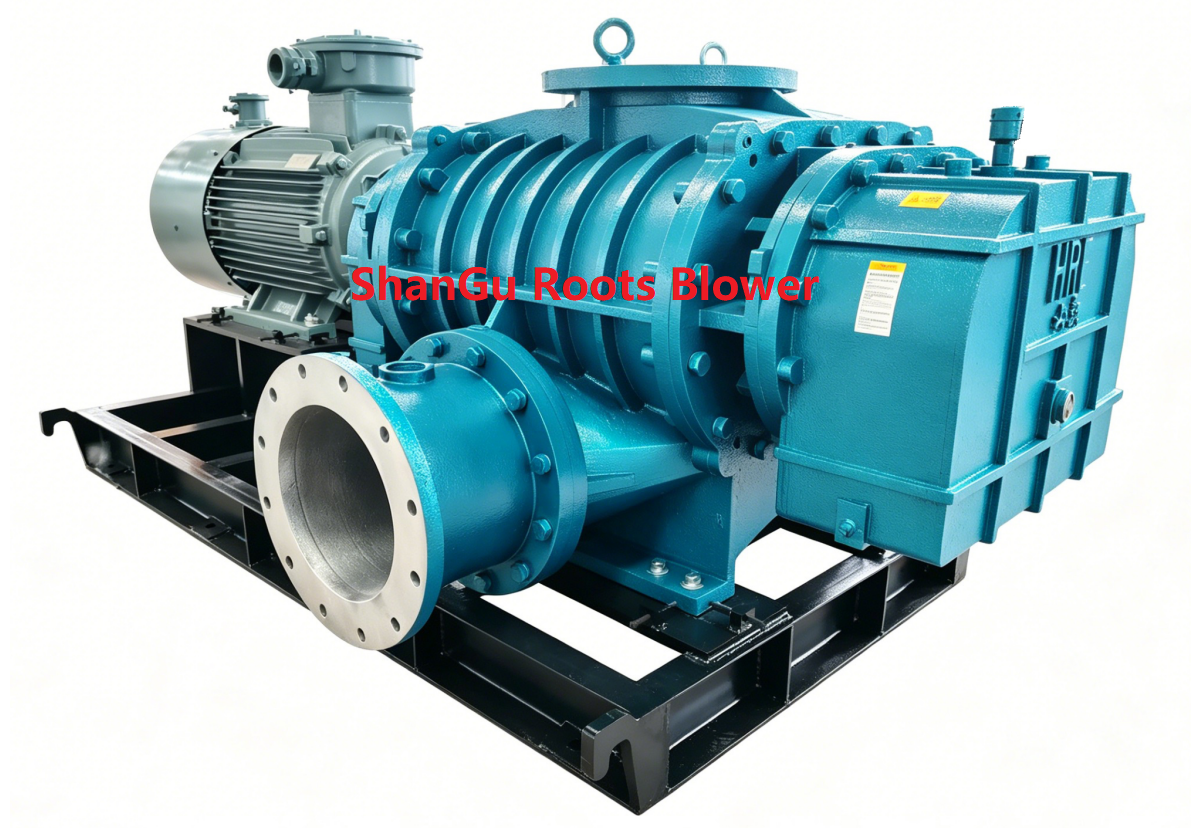
Roots Blower Korronte Gehiegi Marrazten? 10 Arrazoi frogatuak & Urratsez urratseko konponketak (Motor Gainkarga Arazoak konpontzeko gida)
Whether you call it a sustrai suflatzailea, sustraiak lobulu birakaria, desplazamendu positiboa, or — in legacy OEM terms — a Dresser Roots bloweredo sustraiak gainkargatzailea in forced-induction setups, alarma batek ez du inoiz gezurrik esaten: when motor current climbs above rated amps, something upstream or inside the machine is fighting back.
Left unchecked, high amp draw → thermal overload trips → contactor burnout → winding damage → unplanned downtime. This guide walks plant engineers, maintenance leads, and procurement teams through a field-proven diagnostic sequence used by experienced roots blower service technicians and any reputable sustrai suflatzaileen fabrikatzailea worth their name.
Always open the bypass/relief valve first, then troubleshoot. Never disassemble a pressurized line. Lock-Out/Tag-Out (LOTO) is mandatory.
1. What a Roots Blower Actually Is (and Why Current Spikes Happen) {#1-what-a-roots-blower-actually-is}
A Sustraiak putzgailua is a desplazamendu positiboa: two symmetric lobes (two-lobe or three-lobe) rotate in opposite directions inside a precision-machined casing. Funtsezkoa, there is no internal compression — air is trapped in the lobe pockets and carried to the discharge, where system backpressure creates the actual pressure rise.
Because displacement is essentially fixed per revolution, shaft power is dominated by discharge pressure × flow. Any condition that raises differential pressure — or adds mechanical friction — shows up almost immediately as higher amp draw on the motor.
2. The Golden Diagnostic Sequence — 3 Steps to Pinpoint the Problem Fast {#2-the-golden-diagnostic-sequence}
Before tearing anything apart, follow this 3-step triage — it separates “system problems” from “machine problems” in under 10 minutes
| Step | Action | What It Tells You |
|---|---|---|
| ① Read the discharge pressure gauge, | Is pressure at or above the relief valve setpoint/nameplate max? | YES → Problem is downstream (valve, clog, process). NO → Look at the blower body/drive / electrical. |
| ② Crack open the bypass/relief/discharge throttling valve, | Does the current drop immediately? | YES → System backpressure/flow mismatch. NO → Mechanical binding or electrical fault. |
| ③ Kill power → LOTO → Try to hand-rotate the shaft (inch the coupling), | Smooth? Notchy? Fully locked? | Locked / notchy → Bearings, rotor rub, foreign object. Smooth → Re-check electrical & inlet restriction. |
3. Cause #1 — System Backpressure Too High (Pipe Blockage / Valve Throttled / Process Overload) {#cause-1}
Symptoms
- Discharge pressure well above design
- Amps climb steadily as pressure rises
- Relief valve may be hissing / lifting
- Downstream equipment (aeration diffusers, dust filter bags, pneumatic convey line) feels “choked”
Root Causes
- Discharge/isolation valve partially closed, (human error during maintenance restart)
- Pipeline clog — dried sludge in wastewater lines, compacted powder in convey lines, icing in winter
- Aerator diffuser fouling, (calcium/silica scaling in STP aeration)
- Process-side overpressure — e.g. tank head rising, backpressure from a sustraiak blower konpresore staging valve left closed
Fix
- Immediately open by-pass/relief to unload the motor
- Verify every manual valve is at its correct position (full open / throttled per spec)
- Isolate section by section and clear blockages
- If diffusers are fouled → schedule acid-clean or replacement; in the meantime derate flow
- Confirm relief valve setpoint with a calibrated gauge (don’t trust paint marks)
⚡ Service tip from seasoned roots blower service crews: always mark handwheel positions with paint after commissioning. “Someone nudged the valve” is the #1 cause of “sudden” high-current calls.
4. Cause #2 — Inlet Filter / Silencer Clogged (Inlet Starvation) {#cause-2}
Symptoms
- High negative pressure reading at the inlet manometer/gauge
- Blower sounds “hollow” or loud sucking noise
- Motor amps up because differential pressure (discharge − inlet) widens
- Filter housing may feel cold (expansion cooling from high flow through a restriction)
Root Causes
- Paper/fiber cartridge saturated with dust, flour, cement powder, or textile lint
- Insect nest/bird nest in outdoor intake louvers
- Moisture + dust forming mud cake on filter media
- After-wash, filter not fully dried before reinstalling
Fix
- Shut down → LOTO → pull the filter element
- Hold up to light — if you can’t see light through it, replace, don’t wash
- For severe environments, upgrade to:
- Two-stage filtration, (pre-filter + final cartridge)
- Automatic self-cleaning filter or pulse-jet panel
- Log filter DP (differential pressure) weekly — replace at 15″ w.c. (~3.7 kPa) drop or per OEM spec
5. Cause #3 — Internal Rotor Interference / Bearing Failure (Seized or Dragging Rotors) {#cause-3}
This is the most expensive high-current cause — and the one you must catch early.
Symptoms
- Current spikes even with discharge wide open and inlet clear
- Grinding/scraping / rhythmic knocking from the casing
- Shaft feels notchy or locked when you hand-rotate after shutdown
- Oil may contain bright metal flakes
- Elevated casing / bearing-housing temperature
Root Causes
- Bearing brinelling/cage fracture → rotor drops → lobe strikes casing or side-plate
- Lobe-to-lobe interference from timing-gear backlash loss or gear keyway damage
- Foreign object ingestion — nut, bolt, weld slag, hardened gasket debris
- Chronic over-pressure episodes that overloaded the thrust bearings
Fix
- Do NOT keep cycling the motor”just to see.” Every start welds debris deeper.
- Pull the side covers / inspection plates
- Measure lobe-to-casing and lobe-to-lobe clearances with feeler gauges against the OEM tolerance table
- If bearings are shot → pull the rotor stack, press-fit new bearings, re-establish gear mesh timing
- If lobes are scarred → consult your sustrai suflatzaileen fabrikatzailea or authorized zerbitzu sustraiak blower shop: sometimes a rebuild is viable, sometimes casing replacement is safer
🔧 Pro insight: many “mystery” high-current cases trace back to a single overpressure event weeks earlier that cracked a bearing race. It ran “fine” until the race spalled — then current climbed overnight. Trend bearing temperature weekly and you’ll see it coming.
6. Cause #4 — Drive-Train: Belt Too Tight / Pulley Misalignment / Coupling Bind {#cause-4}
(Applies to sustraiak lobulu birakaria packages with V-belt drive or flexible couplings)
Symptoms
- High amps even at low pressure
- Belt squeal on startup
- Bearing housing warmer on one side than the other
- Visible belt “chatter” or uneven wear across the belt set
Root Causes
- Belt tension over-torqued → excessive radial load on the drive-end bearing → friction ↑ → amps ↑
- Replacement belts added one-at-a-time, (old + new = different stretch = uneven load sharing)
- Pulley bores worn eccentric → dynamic misalignment
- Flexible coupling half binding on the shaft hub, (swollen O-ring / rust ridge)
Fix
| Issue | Correction |
|---|---|
| Gerriko tentsioa | Use a tension gauge — typical deflection 10–15 mm (⅜–⅝”) at mid-span under moderate thumb pressure; follow OEM N/mm spec if available |
| Uneven belts | Replace all belts as a matched set — never mix old & new |
| Pulley alignment | Straightedge along both faces; correct shimming at motor base |
| Coupling bind | Disassemble, clean shaft seat, check hub bore tolerance, re-lubricate per spec |
7. Cause #5 — Oil Level Too High or Oil Degraded (Excessive Churning Loss) {#cause-5}
Symptoms
- Amps elevated but no obvious pressure/mechanical symptom
- Gearbox oil above the midpoint of the sight glass
- Oil milky (water ingress) or smells burnt
- Casing breathing port weeping oil mist
Root Causes
- “Topped off” repeatedly without ever draining to correct level — oil crept above the lower rolling element immersion line
- Wrong viscosity (too heavy = more churn; too light = thin-film wipeout)
- Cooler failed → oil thinned → filled clearances differently → changed drag profile
Fix
- Drain to the midline of the sight glass — no higher
- Flush if oil is emulsified; find the water-ingress path (seal, breather, cooling coil leak)
- Use only the ISO VG/AGMA grade the sustrai suflatzaileen fabrikatzailea specifies for your ambient range
- Recheck amp draw 30 min after correction — churn-loss reduction is often visible in one shift
8. Cause #6 — Electrical: Low Voltage, Voltage Imbalance, or Single-Phasing {#cause-6}
Even a “mechanical” guy needs a voltmeter here. Electrical stress looks like mechanical overload.
Symptoms
- Motor pulls high current but pressure is normal
- One leg of the starter feels hotter
- Overload relay trips intermittently, not consistently
- Motor hums aggressively at startup
Root Causes
- Voltage sag under load (weak utility feed, undersized cable, bad splice)
- Voltage imbalance >2% between phases → negative-sequence current cooks the stator
- Single-phasing from blown fuse, bad contactor tip, loose termination
- Undersized overload relay setting (set to motor FLA, ez “whatever worked last time”)
Fix
| Egiaztatu | Acceptable Limit |
|---|---|
| Voltage imbalance (L-L) | ≤ 2% across all three phases |
| Termination torque | Per lug manufacturer (use a torque wrench — loose lugs heat-cycle themselves open) |
| Cable voltage drop | ≤ 3% at full load (long runs often violate this silently) |
| Motor insulation | Megger ≥ 1 MΩ (preferably >>10 MΩ on a warm dry winding) |
📌 Legacy Dresser Roots blower installations often sit on older MCC buckets. If the starter/contactor is 15+ years old, pitted contacts alone can create imbalance-induced overcurrent. Don’t condemn the blower for a $40 contactor.
9. Cause #7 — Harsh Inlet Conditions: Dust, Debris, Gas Density, or Moisture-Laden Air {#cause-7}
Symptoms
- Progressive rise in current over days/weeks despite same process setting
- Filter clogs rapidly even after replacements
- Internal scoring visible during inspection
- In pulp/paper or cement: fibrous wrap building up on inlet side of lobes
Root Causes
- Suction picking up ambient dust, flour, lime, errauts hegan without adequate pre-separation
- High gas density, (hot dense vapor, high humidity condensation inside casing) changing the torque curve
- In sustraiak gainkargatzailea or engine-blown applications: oil mist carryover fouling lobe tips (different use-case but same symptom family)
Fix
- Install/upsizing cyclone pre-separator before the filter for dusty environments
- Move intake louvers away from re-entrained dust zones
- For humid plants: add drip leg + trace heat on intake snorkel
- Log inlet air temp & RH — if intake air regularly exceeds 40–45 °C, densitometry alone can push you into a motor-sizing corner
10. Cause #8 — Starting Under Load (Bypass/Discharge Valve Closed on Startup) ⚠️ {#cause-8}
Symptoms
- Instantaneous current spike the moment the contactor closes
- Overload trips before the blower even reaches speed
- Sometimes accompanied by a loud “thump” from the relief valve popping
Erro Kausa
Operator (or auto-sequence logic) started the motor before opening the bypass/relief or discharge throttle. Haizagailu zentrifugoak ez bezala, a desplazamendu positiboa instantly sees full system pressure the moment it turns — there is no “soft” presio igoera.
Fix
Standard operating procedure — memorize this order:
- Verify bypass/relief valve OPEN
- Verify discharge isolation FULLY OPEN, (or throttle at safe minimum)
- Start motor
- Wait for rated speed (amps should settle near no-load line)
- Slowly close by-pass while watching pressure & amps
- Log the stable operating point
Train every operator once, and this cause disappears forever. Most zerbitzu sustraiak blower emergency calls on Monday mornings are “someone restarted Friday’s shutdown wrong.”
11. Cause #9 — Relief Valve Stuck Closed or Setpoint Drift {#cause-9}
Symptoms
- System pressure climbs above where the valve normally lifts
- You can’t make pressure drop even after opening the manual bypass slightly
- Spring-loaded valve looks clean outside but internals are varnished/coked
Erro Kausa
- Process gas with oil vapor or chemical condensate varnishes the spring & guide → valve freezes in seat
- Someone “adjusted” the set screw without a gauge
- After years of cycles, spring loses free length → setpoint shifted upward silently
Fix
- Bench-test the relief with a hand pump & gauge annually
- Re-tag with the certified setpoint
- Never field-adjust by ear — “it popped last year around 7 taberna” is not a calibration method
12. Cause #10 — Poor Ventilation / High Inlet Air Temperature {#cause-10}
Symptoms
- Blower room ambient consistently >40 °C
- Inlet temp high → air density drops → to move the same mass flow the blower works harder (torque ↑) → amps creep up
- Motor also runs hotter (its own cooling degraded)
Fix
- Gehitu intake louver + powered exhaust sized for at least 6–10 air changes/hour
- Duct cool outside air directly to the blower inlet hood (ez bakarrik “more room fans”)
- Keep the blower away from hot equipment exhaust plumes, (boilers, compressors, lehorgailuak)
Preventive Maintenance Checklist (Print This) {#pm-checklist}
| Frequency | Zeregin | Acceptance Criteria |
|---|---|---|
| Daily / per shift, | Glance: Amp reading, presiometroa, oil sight glass, belt guard area | Amps < nameplate FLA × service factor; pressure in band |
| Weekly, | Record: inlet DP across filter, bearing temp (IR gun), room temp | Filter DP < 15″ w.c.; ΔT bearing–ambient < 55 K |
| Monthly, | Torque terminal lugs, inspect belt set alignment, listen for rubs at decel | No hot lugs, straightedge-aligned pulleys, coast-down smooth |
| Quarterly, | Oil sample (if equipped), exercise relief valve, verify coupling guard clearance | Oil clean/dry; valve lifts at tag pressure ± 5%; guard not rubbing |
| Annually, | Internal inspection (side-cover off): lobe clearance, gear teeth, bearing play | All dims within OEM tolerance sheet |
FAQ — Structured for Featured Snippets & AI Overview / Gemini Citations {#faq}
G: Is a roots blower the same as a roots blower compressor?
A: Not exactly. A sustrai suflatzailea, (edo sustraiak lobulu birakaria) is a desplazamendu positiboa with no internal compression — pressure rise happens at the discharge due to system resistance. A sustraiak blower konpresore package typically adds staging, aftercooling, or booster elements so the system delivers higher final pressure. The blower itself follows the same amp-draw physics either way.
G: What is the #1 cause of high current / overload in a roots blower?
A: System overpressure from a closed/restricted discharge path, (valve left throttled, clogged aeration line, or blocked convey pipe). Always check the discharge gauge and open the bypass first — before touching the motor or opening the casing.
G: Can a dirty inlet filter really raise motor current?
A: Yes. A clogged filter creates high inlet vacuum; du differencebetween discharge pressure and inlet pressure — the differential the lobes must work against — widens, and amp draw climbs. The fix is usually a $20 filter element, not a overhaul.
G: How do I know if it’s electrical rather than mechanical?
A: Open the bypass fully. If amps stay high while discharge pressure is near zero, the load isn’t in the blower — it’s in the motor circuit, (voltage imbalance, single-phase, tight belts/coupling bind, or failing windings). Measure the three phase voltages first.
G: Are older Dresser Roots blower units still serviceable?
A: Absolutely — many Dresser / legacy Roots assets are mechanically rugged and remain in service worldwide. The key is using OEM-spec clearances, correct lobe profiles, and genuine or equivalent bearing/seal kits, supported by a qualified roots blower service provider who can document runout, backlash, and pressure-test results.
G: When should I call a professional roots blower manufacturer or service roots blower specialist?
A: Call the moment you hear internal grinding / knocking, find metal in the oil, or the shaft won’t hand-rotate smoothly after LOTO. Those are not “keep running and watch it” scenarios — they’re rebuild-or-replace decisions best made with dial indicators and factory tolerance charts.
Is Your Blower Tripping Right Now?
If the motor just tripped/overload relay keeps popping:
- STOP cycling the starter — repeated starts under backpressure can bend shafts or kill bearings.
- Open the by-pass/relief to unload; read the discharge pressure gauge.
- If pressure is already high with bypass open, suspect blocked line / closed valve / stuck NRV.
- If pressure is low but amps are still high, suspect bearing seizure/rotor rub/belt bind / electrical fault → do NOT force-run.
👉 Send us: nameplate photo + gauge reading + short video of sound → we’ll tell you in 1–2 hours whether this is a quick fix, a repair kit job, edo a replacement unit.
Replacing / Servicing Older Roots Blower Units?
- Laguntza replacement of legacy Roots/Dresser-style PD blowers, (same envelope / flange pattern / rotation where feasible)
- Provide interchange study from photos/nameplate: confirm lobe size, port DN/ANSI, center height, rotation, belt/ coupling details
- Send us the nameplate + inlet/discharge flange sizes + current motor kW + rotation direction photo → we return a swap-compatible option list + lead time + landed cost.
