
Roots Blower (Positive Displacement Blower / Roots Rotary Lobe Blower): Working Principle, Key Features & Selection Guide
Roots Blower(Positive Displacement Blower):Oil-free, constant-volume airflow for aeration, pneumatic conveying, combustion air, and process-gas duties—built around synchronized twin rotors and precision clearances instead of internal compression.
What Is a Roots Blower(Positive Displacement Blower) ?
A Roots blower—also called a positive displacement blower or roots rotary lobe blower—is a rotary-lobe, positive-displacement air/gas mover.
It does not compress air inside the rotor cavity. Instead, it traps a fixed pocket of gas between two counter-rotating lobed rotors (and the casing), carries that pocket from inlet to discharge, and then displaces it into a higher-pressure system that supplies the backpressure.
How a Roots Blower(Positive Displacement Blower) Works (Step-by-Step)
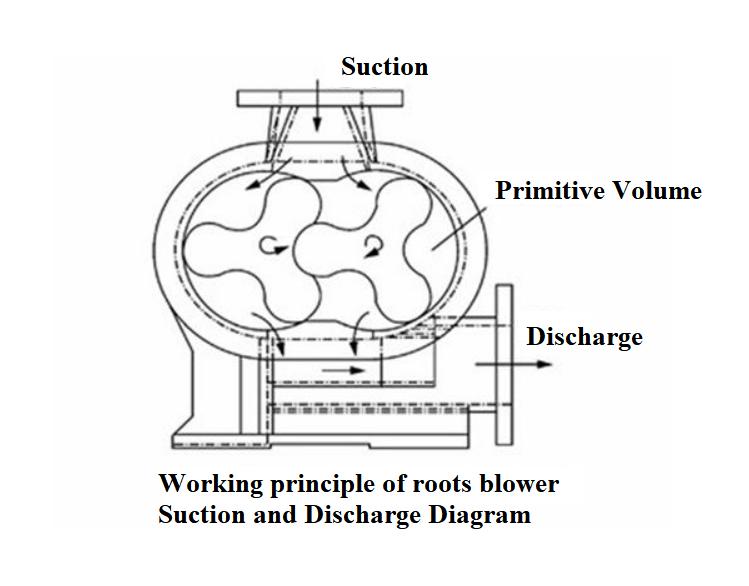
- Intake (air enters)Gas flows through the inlet silencer/filter into the casing. As the lobed rotors rotate apart at the inlet, an expanding pocket draws gas in near inlet pressure.
- Trapped-volume carry (no internal squeeze)Two identical rotors—kept perfectly synchronized by timing gears—rotate at equal speed in opposite directions. The gas pocket is now trapped between lobes and casing and carried around the interior without volume reduction (isochoric carry).
- Discharge & external compressionWhen the pocket opens to the discharge port, higher-pressure gas downstream rushes back momentarily to equalize—then the lobes force the mass into the system. The blower overcomes the outlet-side backpressure (static head + friction + diffuser/dust-filter losses).
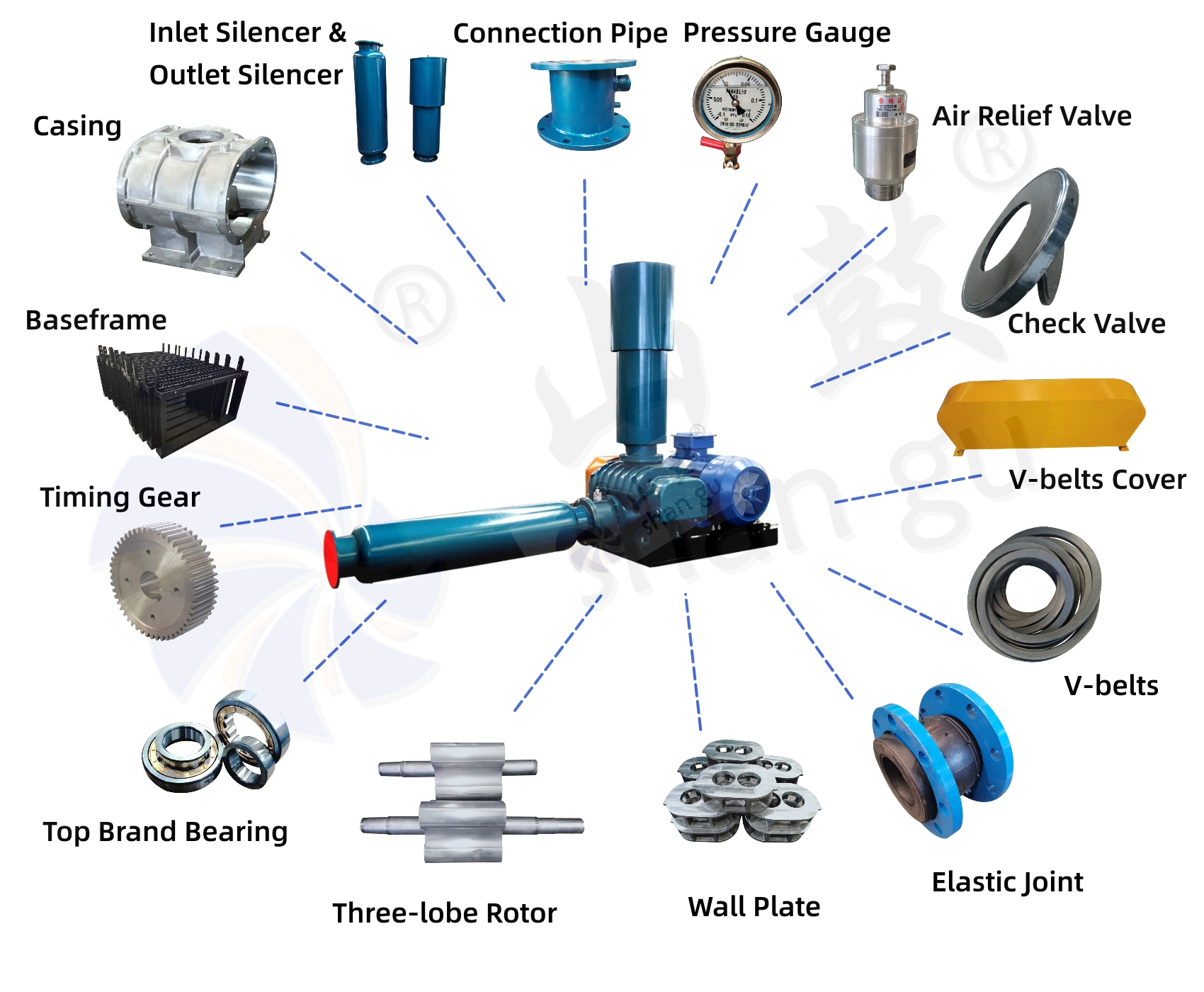
- Protection & discharge train (where your text’s components live)Downstream of the casing you normally see:relief valve / pressure safety → flexible connector (expansion joint) → discharge silencer → non-return/check valve → process piping.This train protects against overpressure/backflow and reduces pulsation & structure-borne noise.
Net result: a near-constant inlet volume flow (CFM or m³/min) that is primarily a function of rotational speed, while discharge pressure is set by the system resistance, not by “squeezing” inside the case.
Two-Lobe vs Three-Lobe Roots Blowers (why three-lobe dominates new projects)
| Feature | 2-lobe Roots blower | 3-lobe Roots blower |
|---|---|---|
| Pulsation & noise | Higher peak pulsation | Smoother discharge, lower pulsation |
| Pressure ripple | More pronounced | Reduced — easier on diffusers/piping |
| Typical use today | Legacy / specific retrofits | Default choice for aeration, conveying, process air |
Most modern industrial orders standardize on three-lobe rotors because the progressive cavity opening/closure reduces shock and noise and improves discharge steadiness—critical for wastewater aeration and fine-bubble diffusers.
Roots Blower vs Centrifugal Blower
| Criteria | Roots / PD lobe blower | Centrifugal fan / blower |
|---|---|---|
| Flow–pressure behavior | Flow ≈ constant with speed; pressure set by system backpressure (within rating) | Flow drops as backpressure rises (performance curve) |
| Compression | No internal compression; pressure builds externally at discharge | Dynamic compression (velocity → pressure) |
| Best fit | Stable-volume, low–medium pressure: aeration, pneumatic conveying, combustion air, vacuum-booster staging | Large-volume, variable-demand or higher-efficiency-at-scale when system curve is favorable |
| Noise profile | Higher pulsation peaks (needs silencers/flex joints) | Generally smoother flow tone, but surging risk if operated too far left of curve |
| Energy nuance | Simpler, robust; efficiency can suffer if you run fixed-speed against varying demand | VFD + impeller geometry can save energy part load in large plant |
Where a Roots Blower Compressor Package Is Used
- Wastewater / STP aeration (fine-bubble diffusers, continuous-duty air)
- Pneumatic conveying (dry bulk: cement, fly ash, plastic pellets, grain)
- Combustion air / kiln air supply (oil-free air path; stable volume)
- Process gas handling (biogas, CO₂, VPSA oxygen plant auxiliaries, etc.—materials/seals selected accordingly)
- Vacuum boost / roots vacuum blower staging (when configured for suction duty)
Quick Selection Checklist
To size a roots blower / roots blower compressor package, send us 6 numbers—we’ll return a matched model & schematic:
- Required flow at site conditions: ______ CFM / m³/min (inlet temp / elevation / humidity if critical)
- Discharge pressure you must overcome: ______ kPa(g) / mbar / psi (include worst-case diffuser/filter fouling margin)
- Gas / air cleanliness: dusty? humid? corrosive? explosive? (ATEX/Ex discussion if needed)
- Duty cycle: continuous? intermittent? start/stop frequency?
- Control preference: fixed-speed with bypass/relief vs VFD for flow trim
- Space & noise limit: indoor/plantroom? dBA target? outdoor skid?
Roots Supercharger vs Industrial Roots Blower
Search engines (and buyers) sometimes mix roots supercharger with industrial blowers because both share the PD lobe-pump DNA.
- An automotive roots supercharger is engine-driven (belt/off crankshaft) and exists to increase manifold pressure (boost) for power.
- An industrial roots blower / positive displacement blower exists to move process air/gas at stable volume against a system backpressure, usually 24/7, with oil-free casing paths, silencers, relief protection, and TCO focus.
FAQs
Q: Is a Roots blower the same as a compressor?
A: The blower element is a positive displacement blower, not a multi-stage dynamic compressor. “Roots blower compressor” usually means a packaged PD system delivering low–medium pressure service (often 9.8–98 kPa / ~1–14 psig for single-stage, higher with staging/different configurations).
Q: What pressure can a standard single-stage roots rotary lobe blower handle?
A: Typical single-stage envelopes are discussed in the ~9.8–98 kPa (≈0.1–1.0 bar g) range; duties above that are evaluated case-by-case (two-stage or alternate tech).
Q: Do Roots blowers deliver oil-free air?
A: In the common dry-casing / gear-lube-separated layout, the air/gas path can remain oil-free—important for aeration, food-adjacent processes, and certain process gases. Confirm seal/lubrication architecture on the datasheet.
Q: Why does my system need a relief valve and check valve?
A: A PD blower can see pressure spike if discharge is blocked or the system resists more than expected. The relief valve protects the machine; the check valve prevents backflow when the unit stops.
Need a Roots blower, positive displacement blower, or a roots blower compressor package sized for your aeration tank, conveyor line, or process gas system?
Share your flow + required pressure + gas type + duty hours, and our engineering team will reply with a matched selection, outline drawing, and ex-works / CIF quote within 24 working hours.
Get a Quote – Roots Blower Selection
