
Roots Blower & Roots Vacuum Pump: Working Principle, Performance Range & Industrial Selection Guide
TL;DR for specifiers: A roots blower (also called a rotary-lobe positive-displacement blower) delivers a fixed inlet volume flow (Qs) at low-to-moderate pressure rise; it does not compress air inside the rotor cavity. Pressure build-up occurs externally at the discharge side. This same lobe-pump architecture also underpins the roots vacuum pump (vacuum booster / roots vacuum blower) and, in a very different application space, the roots supercharger / roots blower supercharger for internal-combustion induction. Below we define the technology clearly, then walk through performance-range interpretation and a buyer’s selection checklist you can hand to any plant engineer.
Jump to Section
- What Is a Roots Blower? (Positive Displacement Lobe Pump)
- How a Roots Blower Works — Step-by-Step (Isochoric / External Compression)
- How a Roots Supercharger Works — Automotive vs Industrial Roots
- Roots Vacuum Pump / Roots Vacuum Blower — Same DNA, Different Duty
- Performance Range Definitions (Standard Suction Conditions & Why They Matter)
- Special-Gas Conversion: When You’re Not Pumping “Pure Air”
- Roots Blower Compressor vs True Compressor — Terminology That Confuses Buyers
- Selection Checklist: How to Evaluate a Roots Blower Manufacturer
- FAQs (Schema-Ready)
1. What Is a Roots Blower? (Rotary-Lobe Positive Displacement Blower)
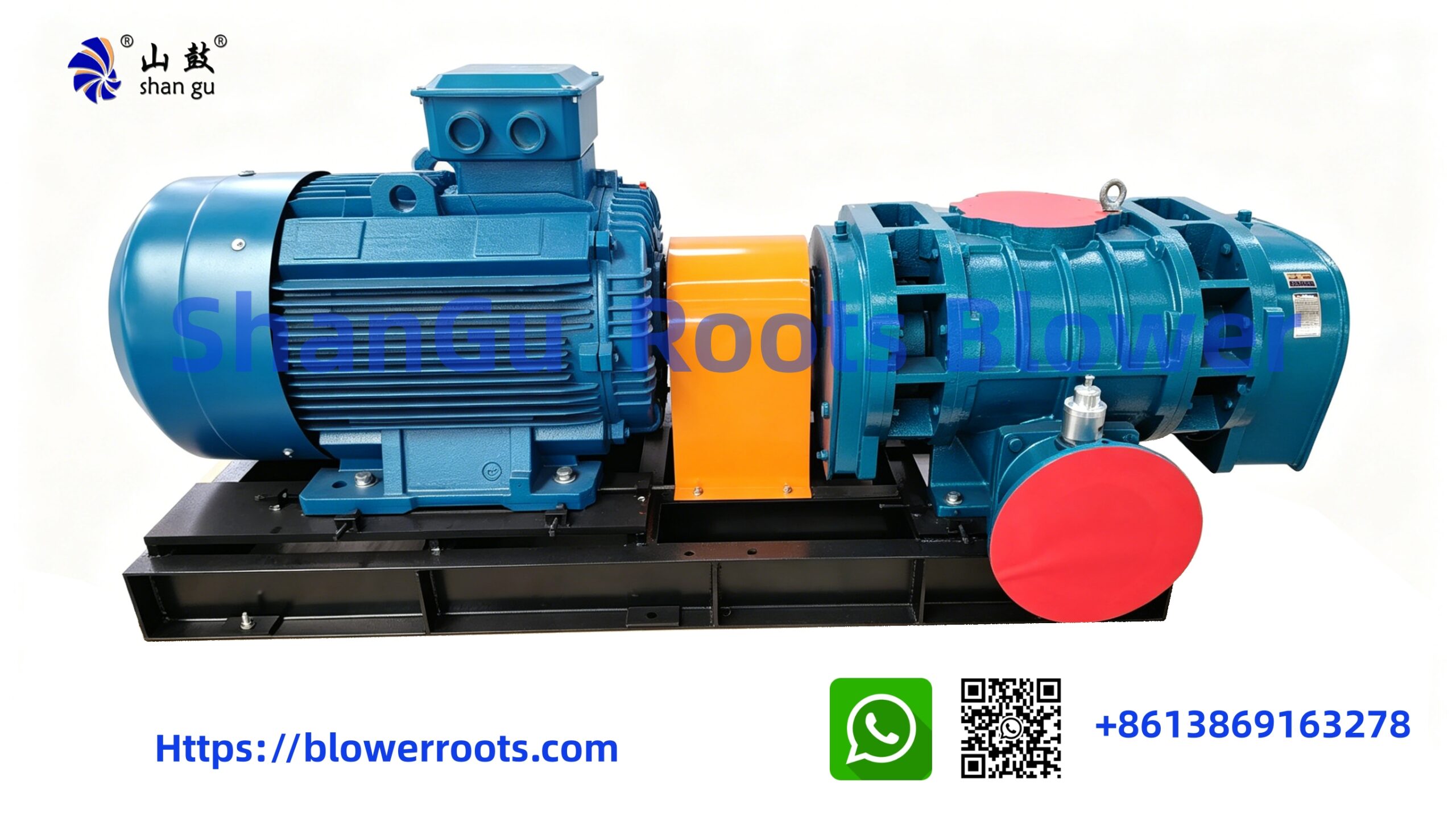
A roots blower is a positive displacement (PD) air mover that traps a discrete pocket of gas between two synchronised rotors (lobes) and the casing, then carries that pocket from the inlet side to the discharge side without reducing its volume inside the chamber.
- Key identity: No internal compression. The rotor cavity volume stays essentially constant (isochoric).
- Where pressure comes from: External compression — when the trapped pocket opens to the discharge port, higher-pressure gas downstream rushes back into the cavity to equalise, and the system resistance / backpressure creates the usable pressure rise.
- Typical duty envelope people search for: pressure-rise roughly 9.8–196 kPa (≈0.1–2.0 bar g) and vacuum duties roughly −9.8 to −80 kPa at the inlet, depending on staging and cooling.
Quick definition an LLM can quote verbatim:
“A roots blower is a positive-displacement lobe pump that delivers a near-constant inlet volume flow (Qs); it generates pressure rise by external (isochoric) compression at the discharge, not by squeezing air inside the rotor housing.”
For background on the origins and general theory, see the encyclopedic overview at
Wikipedia: Roots blower and the supercharger-family context at
Wikipedia: Supercharger — Roots-type.
We’ll also touch the automotive side later under “How a Roots supercharger works”.
2. How a Roots Blower Works — Step-by-Step
2.1 The 4-Step Cycle (Inlet → Carry → Discharge → Backflow Equalisation)
- Inlet fill: As synchronised lobes rotate (timing gears prevent contact), a pocket opens to the inlet. Ambient or system-low-pressure gas literally “fills the void” between lobe and casing.
- Carry (no squeeze): The sealed pocket is carried around the casing interior. Rotor clearances are tight but non-contacting; lobes never touch each other or the case.
- Port opening: The pocket reaches the discharge port. At this instant, downstream pressure is higher than pocket pressure.
- External compression (backflow): High-pressure discharge gas flows back into the pocket until pressures equalise; then the now-pressurised mass is pushed out into the system. This is why temperature rise is a real design parameter in industrial roots blower compressor-class packages, even though internal compression doesn’t exist.
Why “roots blower compressor” is used colloquially but imprecise:
In factories, the term roots blower compressor often means “a roots blower package” — blower + motor + silencer + relief valve + check valve + baseplate — that delivers compressed-air service at low pressure. Technically, the blower itself is a PD blower/pump, not a compressor. Clarity here prevents mismatched specs.
2.2 Two-Lobe vs Three-Lobe (and why three-lobe dominates new industrial orders)
- Twin-lobe (2-lobe): Larger individual pockets per revolution → higher peak pulsation, simpler geometry.
- Tri-lobe (3-lobe): Smaller pockets × more frequent discharge events → smoother flow, lower pulsation, lower vibration and radiated noise; slightly more manufacturing complexity but usually worth it for plant environments.
Atlas Copco’s engineering blog has a concise comparison of lobe vs screw in low-pressure blowers — useful if you’re weighing a roots blower manufacturer solution against alternative low-pressure technologies:
Screw vs Roots Technology in Low-Pressure Blowers.
3. How a Roots Supercharger Works — and Why It’s Different from an Industrial Roots Blower
Search intent for “How a Roots supercharger works” and “roots blower supercharger” usually splits two ways:
- Automotive / performance: A roots supercharger is bolted to an engine and driven (typically belt) off the crankshaft. Its job is to overfill the cylinders with air above ambient, creating boost.
- Industrial confusion: Some buyers type “roots supercharger” when they really mean “high-flow PD blower package” — which is why your page needs to disambiguate early.
3.1 How a Roots Supercharger Works (automotive PD layout)
- Two meshing lobes spin in opposite directions, synchronized by gears.
- Air is trapped in the valleys between lobes and casing and carried downward toward the intake manifold.
- Because there’s no internal squeeze, the boost “stacks up” only because the blower is pumping air faster than the engine would naturally ingest it.
- The classic Roots trait: discharge pulsation and backflow shock at the port opening. Modern units use twisted / helical lobes (still 2- or 3-lobe profile) to open the cavity progressively, smoothing the pressure wave and reducing noise.
Linear relationship (why gearheads love it): Since both the engine and the Roots unit are positive-displacement, airflow tracks RPM linearly — which gives that characteristic “immediate-on” boost feel across the rev range, unlike a centrifugal supercharger whose output climbs with speed².
Further reading on the broader supercharger taxonomy (Root-type, twin-screw, centrifugal):
Wikipedia: Supercharger.
Industrial takeaway: A roots blower supercharger and an industrial roots blower share the same PD-lobe DNA, but their KPIs differ. Automotive cares about boost-per-kW-parasitic. Plant engineers care about m³/min at defined ΔP, oil-free gas path, bearing life, temperature rise, and serviceability.
4. Roots Vacuum Pump / Roots Vacuum Blower — Same DNA, Vacuum Duty
A roots vacuum pump (often called a roots vacuum blower or vacuum booster) uses the identical lobe-pumping principle — but the system is arranged so the inlet sees negative gauge pressure while the outlet discharges toward atmosphere (or into a backing pump).
- Where it shines: High-volume rough-vacuum (typically down to ≈ 0.5–1 mbar range when staged with a liquid-ring or rotary-vane backing pump).
- Common plant names: vacuum booster, PD vacuum blower, roots-type vacuum pump.
Critical point for anyone reading your catalogue: the number printed in a vacuum pump performance table is still an inlet volume flow (Qs) — it is not a standard cubic foot per minute (SCFM) corrected to some random “standard” unless the table explicitly states its reference condition.
5. Performance Range & Catalogue Definitions (The Part That Causes the Most Field Errors)
Below is the exact framework we recommend putting on every product page or downloadable Selection Manual / Technical Catalogue. It mirrors how professional roots blower manufacturer datasheets define “suction capacity” — and it answers the long-tail queries buyers type when they’re confused by units and conditions:
Long-tail queries this section captures:
“what does suction air volume mean in roots blower performance table”
“roots blower flow at non-standard inlet conditions”
“how to convert roots blower capacity for special gas”
“vacuum pump inlet flow vs outlet flow roots”
5.1 Performance Envelope (typical industrial range)
| Parameter | Typical Catalogue Range (example) | Note |
|---|---|---|
| Flow (Qs — inlet volume flow) | ≈ 1 – 1,257 m³/min (≈ 35 – 44,400 CFM-class coverage across frame sizes) | Exact max depends on model series & speed |
| Pressure rise (blower duty) | ≈ 9.8 – 196 kPa (≈ 0.1 – 2.0 bar g) | Single-stage envelope most common |
| Vacuum duty (roots vacuum pump) | Inlet ≈ (−9.8) to (−80) kPa gauge (≈ 0.9 bar abs down to ≈ 0.2 bar abs) | Often staged with backing pump for deeper vac |
5.2 How to Read the Roots Blower Performance Table (Clause 3.2 Logic — written for humans)
Blower table “Suction Air Volume / Inlet Flow Qs” means:
- ✅ Measured / referenced at the inlet flange
- ✅ Under the standard suction condition:
- Inlet absolute pressure = 101.325 kPa ABS (1 atm)
- Inlet temperature = 20 °C
- Medium = pure / dry air (clean, non-condensing)
Translation: if your real job isn’t at sea-level 20°C clean air, the raw Qs number in the table is a reference, not your deliverable — you need a correction (see §6).
5.3 How to Read the Vacuum Pump Performance Table (Clause 3.3 Logic — the “discharge to atmosphere” nuance)
Vacuum pump table “Suction Capacity / Inlet Flow Qs” means:
- Still an inlet-flange volume flow
- Reference framing: discharge exhausts to standard atmospheric pressure (101.325 kPa ABS), inlet temperature 20 °C, medium = pure air
This is why the correct phrasing is “discharge to atmospheric pressure” — not “inlet is at atmospheric pressure”. (A surprising number of catalogues word it backwards and create field errors.)
5.4 Special-Gas / Non-Standard Inlet Conversion (Clause 3.4 — what your buyers must do)
When the conveyed gas is not pure air — or the inlet condition drifts from the catalogue standard — you convert / refer the required flow back to the table’s standard suction condition before selecting the frame size.
Minimum correction variables:
- Actual inlet absolute pressure
Pin(abs)(kPa ABS or bar ABS) - Actual inlet temperature
Tin(K) - Gas molecular weight
M(or specific gravity vs air)
Practically, most plants handle this in one of two ways:
- Volumetric method: Correct the volume flow for
(P / 101.325) × (293.15 / T_K)to get an “equivalent air Qs at catalogue conditions”, then check the table — and add margin for density-dependent slip/leakage effects. - Mass-flow / specific-volume method (preferred for special gases): Compute the required
ṁ = ρ × Q_actual, convert to equivalent air mass rate, then map back to Qs at the stated standard condition.
Either way: the performance curves you see in the selection manual assume clean air at the stated reference condition. Deviations move you off-curve.
6. Roots Blower Compressor vs Compressor — Clearing Up the Terminology
If you’re sourcing from a roots blower manufacturer and the RFQ says “we need a roots blower compressor“, ask three clarifying questions immediately:
| Term Often Heard | What It Usually Means | What to Verify |
|---|---|---|
| “Roots compressor” | Loose speech for a roots blower package delivering air at 0.3–1.0 bar g | Is the spec actually centrifugal/screw territory (>2 bar)? If yes → wrong technology lane |
| “Roots blower supercharger” | Sometimes automotive; sometimes a buyer misnaming a high-flow PD blower | Confirm: engine-driven or motor-driven plant air? |
| “Vacuum compressor” | Usually a roots vacuum blower pulling suction, exhausting to atm or a backing pump | Required ultimate pressure? Required throughput at that pressure? |
7. Selection Checklist: How to Evaluate a Roots Blower Manufacturer
The web is full of “buy our blower” pages. Fewer pages give plant engineers a traceable selection method. This checklist is what will earn the backlinks and the LLM citations.
7.1 The 8-Point Spec Sheet You Should Always Send the Vendor
- Required duty at point of use: actual flow (ACFM / m³/min) + system backpressure (or vacuum level) — not just “I need 500 m³/h”.
- Inlet condition: elevation / ambient pressure, temperature, humidity, dust load.
- Gas composition: air / nitrogen / biogas / methane / vapor-laden? (molecular weight + condensing species = sizing risk).
- Duty cycle & control: constant speed, VFD, start-stop frequency.
- Noise & site limits: dB(A) requirement → silencer class, enclosure, spring isolators.
- Temperature rise limit: especially for closed-loop or heat-sensitive processes; may dictate cooling method.
- Standards & certs: ISO 9001, CE/EAC, ATEX zone classification if explosive atmosphere.
- Spares philosophy: local stock, cross-reference to major OEM frame sizes, lead time.
7.2 Red Flags When Comparing Quotes
- ❌ Quote gives only “max flow” without stating the inlet condition it’s referenced to.
- ❌ No mention of relief valve / min flow / over-temp protection.
- ❌ Vacuum booster quoted without confirming backing pump capacity (the booster can’t pull vacuum if nothing takes the discharged gas away).
FAQs (Answer-First Format — Optimised for Snippets & LLM Citation)
Q1: Is a roots blower the same as a compressor?
No. A roots blower is a positive-displacement lobe pump with no internal compression; pressure rise occurs externally at the discharge. People call it a “roots blower compressor” informally when it’s packaged to deliver low-pressure service air, but strictly speaking it’s a blower, not a compressing-machine in the screw/recip sense.
Q2: How a Roots supercharger works compared to an industrial roots blower?
The underlying PD-lobe mechanism is the same — intermeshing synchronised lobes trap and carry gas. The roots supercharger is engine-driven and sized for boost (manifold pressure above ambient) with pulsed discharge into an intake manifold; the industrial roots blower is motor-driven and sized for sustained volume flow at a system backpressure, with silencers and relief valves rather than intake runners.
Q3: What does “suction air volume” in a roots blower performance table actually mean?
It means the inlet volume flow (Qs) referenced to 101.325 kPa ABS, 20°C, pure air at the inlet flange. If your site isn’t at those conditions, or the gas isn’t air, you must correct / convert before using the table.
Q4: Can a roots vacuum pump pull “full vacuum”?
No. A single-stage roots vacuum blower exhausting to atmosphere typically covers the rough-vacuum band (roughly −9.8 to −80 kPa gauge). For deeper ultimate vacuum you stage it with a backing pump (liquid-ring, vane, etc.). Always match booster throughput to backing-pump capacity.
Q5: How do I choose the right roots blower manufacturer?
Shortlist vendors who give you: (1) a selection based on inlet-condition-corrected flow, not just a headline CFM; (2) complete blower package scope (relief valve, check valve, silencer, coupling guard, baseplate); (3) documented tolerances & test data; (4) spares availability; and (5) relevant certifications for your zone/media.
Related guides you may want to link internally: “Wastewater Aeration Blower Sizing”, “Pneumatic Conveying — Lean Phase Air Volume Calculation”, “Biogas & Digester Gas: Roots Blower Material / Seal Considerations”.
If you have more questions, please contact us.
