
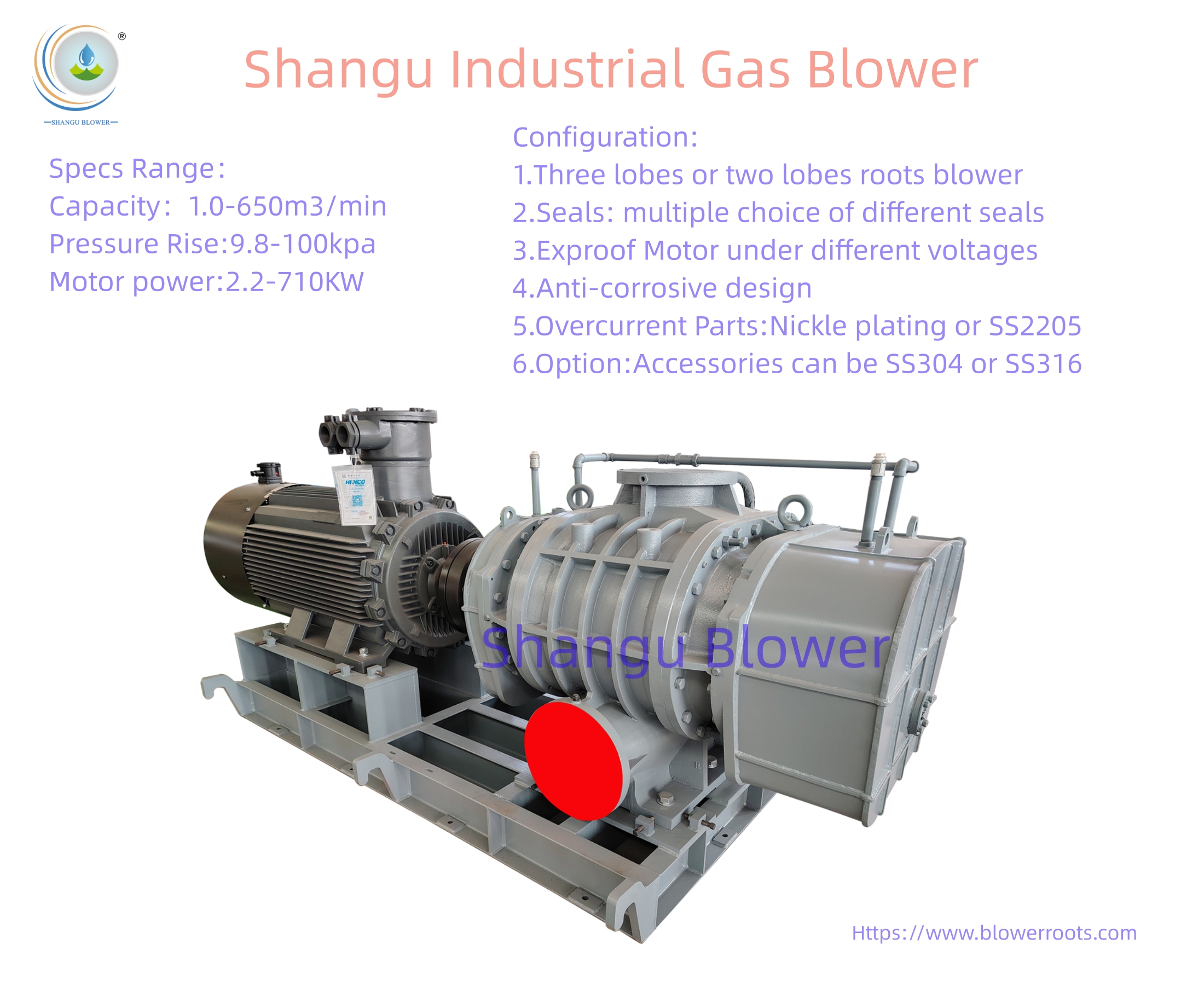
Industrial gas blower packages (also known as Roots compressors),in the realm of industrial gas handling, have emerged as indispensable equipment for transporting and pressurizing gases across diverse sectors. Their unique design and operational principles make them particularly suited for handling special gases such as corrosive, flammable, or high-purity compounds. Below, we explore the distinct advantages of Industrial gas blower packagess in specialized gas transportation, supported by technical insights and real-world applications.
1. High-Pressure Stability & Flow Consistency
Roots blowers excel in maintaining stable flow rates even under fluctuating pressure conditions. Unlike centrifugal compressors, which suffer from efficiency drops under high-pressure scenarios, Roots blowers utilize a dual-rotor system (two or three lobed rotors) to generate consistent displacement. This design ensures minimal flow variation (±1% fluctuation) across pressure ranges of 9.8–250 kPa, making them ideal for critical applications like:
Chemical processing: Transporting toxic gases (e.g., chlorine, hydrogen sulfide) with pressures up to 200 kPa .
Oil and gas: Pressurizing natural gas or flare gas in refineries, where pressure stability is vital for combustion efficiency.
Semiconductor manufacturing: Delivering ultra-high-purity nitrogen or argon with contamination-free delivery .
2. Corrosion Resistance & Material Durability
Specialized gas applications often involve aggressive chemicals or abrasive particulates. Roots blowers address this through:
Material selection:
Copper or SS2205 stainless steel rotors for resistance to acids (e.g., sulfuric acid) and chlorides .
Hard-coated seals(e.g., Pistol Ring+back flow) to withstand abrasive dust in metallurgical or mining sector
Sealing innovations:
Multi-stage labyrinth seals reduce leakage rates to <0.001%, ensuring gas purity in pharmaceutical or food-grade applications .
3. Explosion-Proof & Safety-Critical Design
For flammable gases like methane or hydrogen, Roots blowers incorporate:
Non-lubricated operation: Eliminates oil contamination risks, critical for gas purity in refinery FCC units or hydrogen fuel cells .
ATEX/IECEx certifications: Motors and casings designed to prevent ignition sources in explosive atmospheres.
Pressure relief systems: Integrated safety valves to handle overpressure scenarios, as seen in LNG terminal gas recovery systems .
4. Energy Efficiency & Low Operational Costs
Industrial gas blower packages outperform traditional compressors in specific niches:
Low specific energy consumption: Achieve 75–89% efficiency in medium-pressure ranges (50–150 kPa), reducing energy costs by 15–30% compared to reciprocating compressors .
Variable speed drives (VSD): Adjust rotational speed (150–3,000 RPM) to match demand, slashing power waste during partial-load operations .
Minimal maintenance: With only two moving parts (rotors), annual downtime is reduced to <24 hours, as reported in cement plant case studies .
5. Customizable Solutions for Extreme Conditions
Roots blowers are adaptable to harsh environments:
High-temperature resilience: Cooling jackets and heat-resistant greases enable operation at 60°C+ in steelmaking blast furnaces .
Anti-corrosion coatings: Epoxy or fluoropolymer linings extend service life in chlorine gas pipelines by 3–4 times .
Dust-tolerant configurations: Inlet cyclones and self-cleaning filters handle particulate loads up to 1,000 mg/m³, common in biomass gasification plants .
